Cover art for Meister Eckhart and the Gospel of Thomas: rippling concentric circles radiating from a point of golden light on a deep blue gradient

Meister Eckhart and the Gospel of Thomas: Two Voices, One Teaching

Around the year 1300, the most celebrated preacher in Germany told his congregations that God gives birth to his Son inside the human soul, and that the birth is happening now. Six centuries later, an Egyptian farmer dug up a banned gospel teaching that the kingdom of God is inside you, spread out and present, waiting to be noticed. The preacher never read that gospel. Nobody in his world could have. By his lifetime every known copy had been sealed in a jar beneath the desert for roughly nine hundred years, and it stayed there for six hundred more. Put his sermons beside its sayings, though, and the two begin finishing each other’s sentences. ...
August 5, 2026 · 7 min · Jeremy Matthews
Cover art for Jung's Seven Sermons to the Dead: rippling concentric circles radiating from a point of golden light on a deep blue gradient

Jung's Seven Sermons to the Dead

On a summer Sunday in 1916, the front doorbell of Carl Jung’s house on Lake Zurich began ringing frantically. The whole family heard it, and the maids in the kitchen could see the bell plate swinging. Nobody stood at the door. The days leading up to it had been strange in his telling. His children were having anxious dreams, the air of the house felt thick, and Jung described the place as feeling crammed full of presences. Out of that crowded atmosphere came, as he experienced it, a question from the dead, and over three evenings he wrote them an answer. The haunting, he reported, ended the moment his pen touched paper. ...

August 4, 2026 · 6 min · Jeremy Matthews
Cover art for Golems, Talos, Homunculi: rippling concentric circles radiating from a point of golden light on a deep blue gradient

Golems, Talos, Homunculi: The Oldest Dream of Making Minds

Artificial intelligence feels like the newest thing in the world. The dream behind it might be one of the oldest stories we tell. Nearly three thousand years ago, Homer described the workshop of Hephaestus, the smith god. Assisting him were servants he had forged out of gold in the shape of young women, and the poet is oddly specific about them. They had understanding in their hearts, they could speak, and they steadied their limping maker as he walked. The first androids in Western literature appear in its first great poem, and they appear as helpers. ...

August 3, 2026 · 7 min · Jeremy Matthews
Cover art for AI as a Journaling Companion: rippling concentric circles radiating from a point of golden light on a deep blue gradient

AI as a Journaling Companion: A Modern Examen

Before sleep each night, Seneca put out the lamp and put his day on trial. He scanned everything he had done and said since morning, retracing his steps without excuses. The Pythagoreans were doing a version of it five centuries earlier, refusing to let sleep close their eyes before reviewing each act of the day. The habit is older than Christianity and simpler than almost anything we call spiritual practice. ...

July 28, 2026 · 5 min · Jeremy Matthews
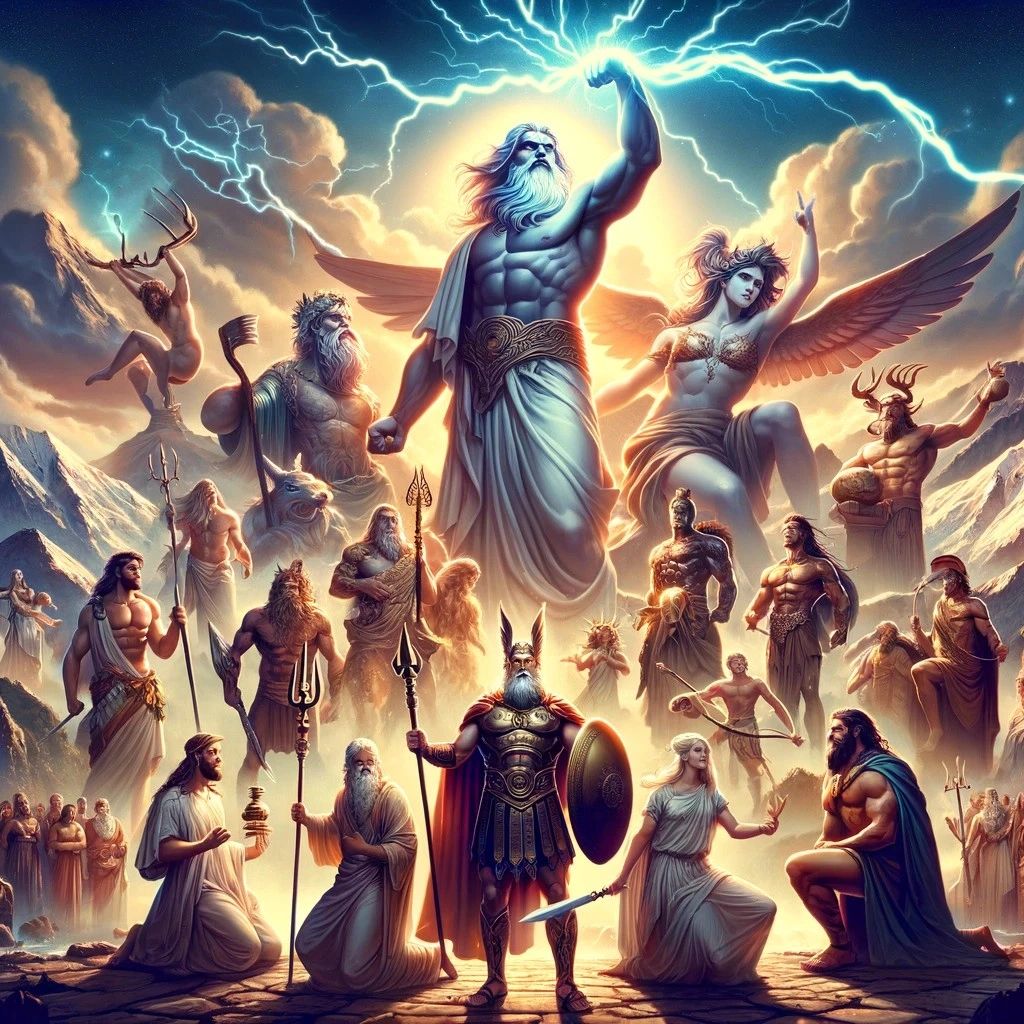
Zeus raises his fist toward lightning bolts, surrounded by the assembled gods and heroes of the Greek pantheon

An Overview of Greek Mythology

Greek mythology grew out of human imagination and the old urge to explain the world’s mysteries. This ancient system encompasses gods, goddesses, heroes, and monsters embodying natural forces and human characteristics. The Major Pantheon The primary deities resided on Mount Olympus, each governing specific domains: Zeus: King of gods, ruler of sky and thunder Hera: Queen of gods and goddess of marriage and childbirth Poseidon: God of the sea, earthquakes, and horses Demeter: Goddess of agriculture, harvest, and fertility Athena: Goddess of wisdom, warfare, and crafts Apollo: God of sun, music, healing, and prophecy Artemis: Goddess of hunt, wilderness, and childbirth Ares: God of war’s brutal aspects Aphrodite: Goddess of love, beauty, and desire Hephaestus: God of fire and metalworking Hermes: Messenger god and guide to the Underworld Hestia: Goddess of hearth, home, and family History and Creation Myth The myths evolved over centuries, influenced by Minoan and Mycenaean civilizations. Homer’s Iliad and Odyssey, along with Hesiod’s Theogony (circa 8th century BCE), codified oral traditions into literary form. ...

February 8, 2024 · 2 min · Jeremy Matthews
The ibis-headed Egyptian god Thoth in jeweled gold and turquoise regalia inside a golden temple

Thoth the Atlantean

Origins and Contributions Thoth emerges as a legendary figure bridging ancient Egyptian and Atlantean traditions. According to mythological accounts, he hailed from Atlantis and brought advanced knowledge to Egypt following his civilization’s fall. Tradition credits him with inventing the Egyptian hieroglyphic writing system and introducing systematic knowledge across astronomy, mathematics, law, and magical practices. Relation to Hermes Trismegistus The Greek-Egyptian syncretization produced Hermes Trismegistus, literally “Hermes the Thrice-Greatest.” This composite deity merged Thoth’s Egyptian wisdom attributes with Hermes’ role as divine messenger. During the Hellenistic period, this figure became central to Hermeticism, a religious, philosophical, and esoteric tradition that espouses a worldview of hidden knowledge. ...

February 8, 2024 · 1 min · Jeremy Matthews
Aerial view of a circular island city with concentric rings of canals surrounding a crystalline central spire

Unraveling the Mystery of Atlantis: From Plato's Tales to Modern Theories

Plato’s Account of Atlantis The oldest mentions of Atlantis appear in Plato’s dialogues “Timaeus” and “Critias,” composed around 360 BCE. Plato depicted Atlantis as a powerful and advanced kingdom that existed about 9,000 years before his time, positioned beyond the “Pillars of Hercules.” He portrayed it as a sophisticated naval civilization that eventually sank into the ocean as divine punishment following its defeat by the Athenians. Scholars continue debating whether Plato intended this narrative as historical fact, philosophical metaphor, or mythological tale. ...

February 8, 2024 · 2 min · Jeremy Matthews
A serene Buddha meditates on an ornate floating lotus throne before a glowing sun, surrounded by clouds and floating lanterns

Understanding Buddhism: Its Core Beliefs and Practices

Introduction Buddhism is among the world’s oldest religions, spanning over two millennia with followers across Asia and globally. Originating in the 6th to 5th century BCE in Nepal and India, it was founded by Siddhartha Gautama, known as the Buddha or “the awakened one.” The faith represents a rich amalgamation of philosophical teachings and spiritual practices that have evolved into diverse traditions. The Four Noble Truths The foundation of Buddhist philosophy rests on the Four Noble Truths, which diagnose the human condition and prescribe remedies akin to medical treatment: ...

February 8, 2024 · 2 min · Jeremy Matthews
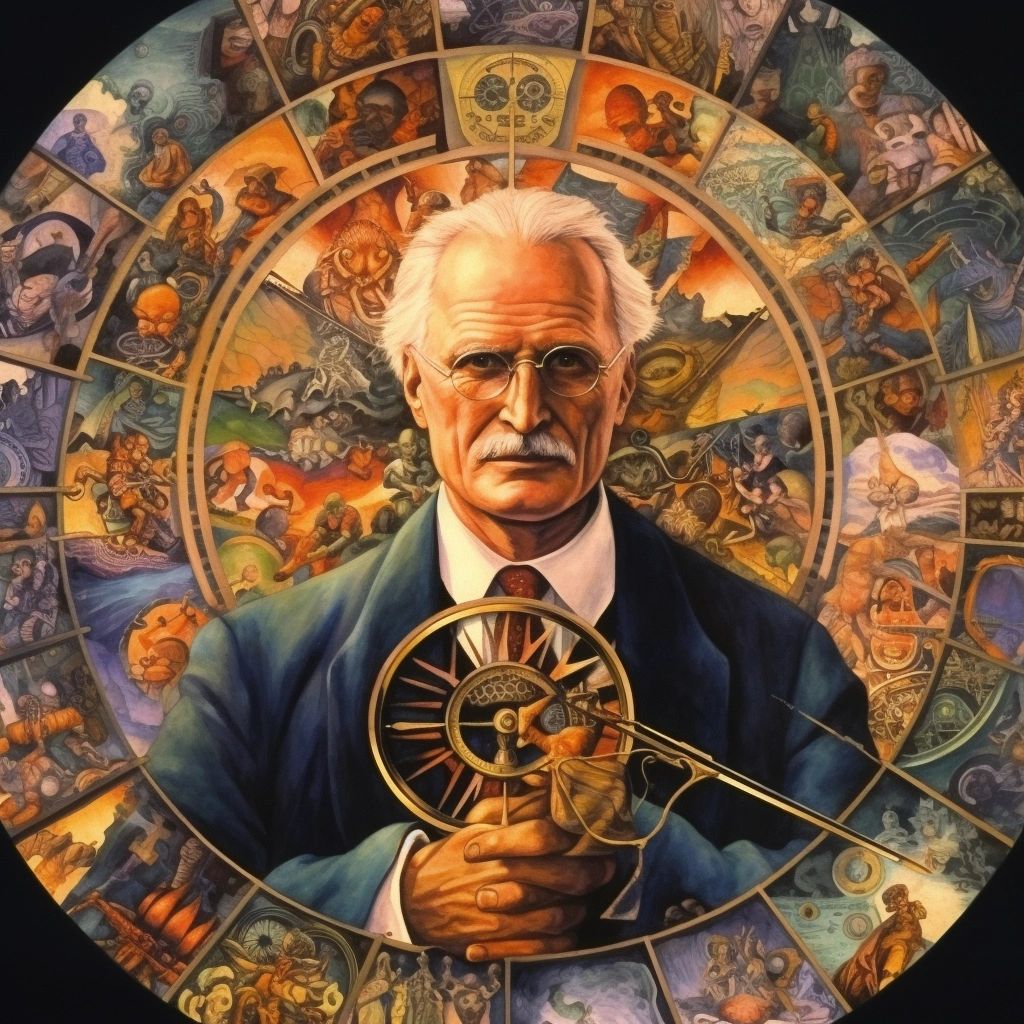
Illustrated portrait of Carl Jung holding an astrolabe at the center of a mandala of archetypal scenes

Carl Jung: His Life and Contributions to Psychology

Carl Gustav Jung was born on July 26, 1875, in Switzerland and became a pioneering psychiatrist and psychoanalyst who established analytical psychology as a distinct field. His influential work extended across psychiatry, anthropology, archaeology, literature, philosophy, and religious studies. Early Collaboration and Divergence Jung initially collaborated closely with Sigmund Freud, contributing significantly to psychoanalytic theory development. However, theoretical disagreements led him to forge his own path and develop independent psychological frameworks. ...

February 7, 2024 · 2 min · Jeremy Matthews
A glowing figure descends through parted clouds in a column of radiant light toward a person standing in still water

How to Apply Gnosis to Attain Inner Harmony

Introduction The Gnostic myth, particularly the narrative of the Fall of Sophia, offers psychological and spiritual insights that can be applied to our personal lives and inner development. This ancient framework provides a metaphorical lens for understanding the human psyche, self-awareness, and the pursuit of meaning. The Inner Sophia: Wisdom and Folly Within Sophia represents the dual aspects of human consciousness, both wisdom and folly. Just as Sophia’s desires lead to an unintended fall, individuals encounter their own challenges through unconscious drives, ignorance, or misplaced understanding. This fall represents an invitation to explore one’s inner depths, confronting shadows, fears, and avoided aspects of self. From there the movement runs from unconsciousness toward greater self-awareness. ...

February 7, 2024 · 2 min · Jeremy Matthews