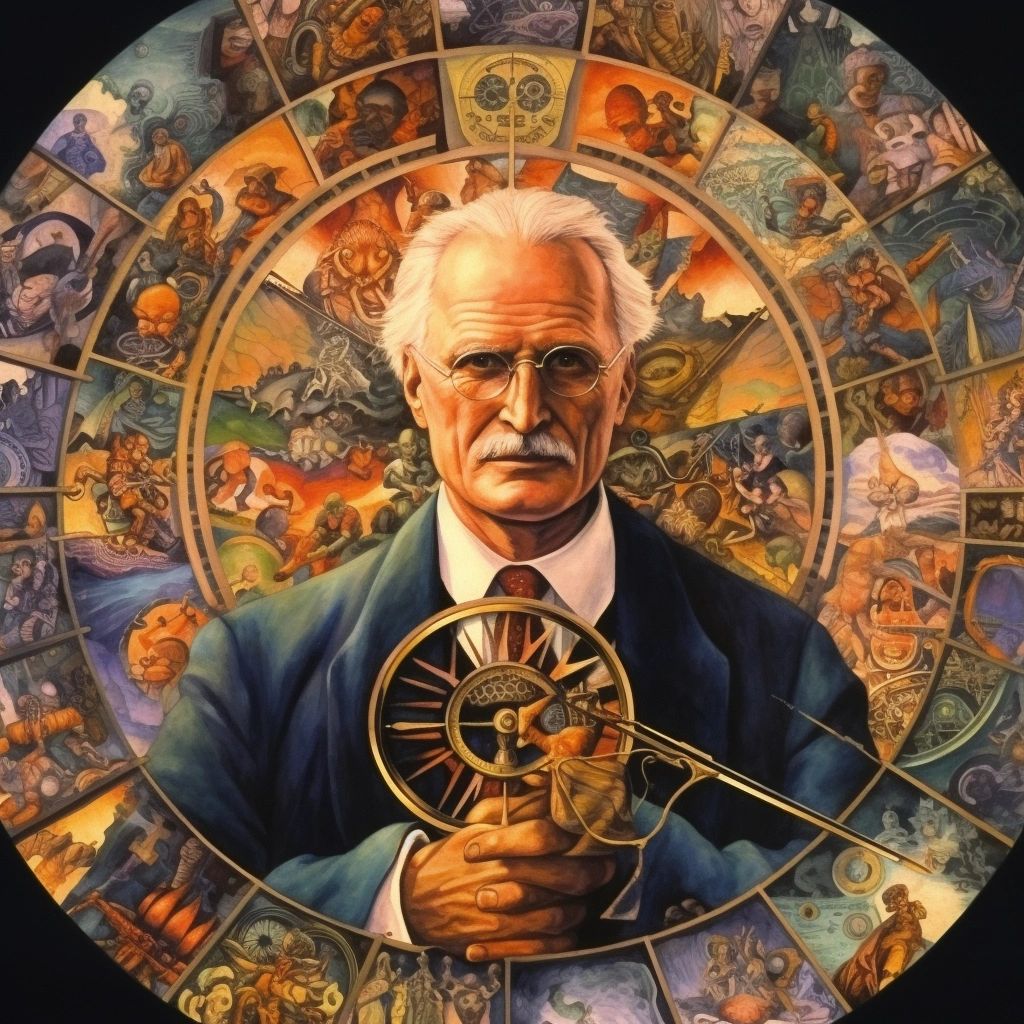
Carl Gustav Jung was born on July 26, 1875, in Switzerland and became a pioneering psychiatrist and psychoanalyst who established analytical psychology as a distinct field. His influential work extended across psychiatry, anthropology, archaeology, literature, philosophy, and religious studies.
Early Collaboration and Divergence
Jung initially collaborated closely with Sigmund Freud, contributing significantly to psychoanalytic theory development. However, theoretical disagreements led him to forge his own path and develop independent psychological frameworks.
Major Contributions to Psychology
The Collective Unconscious and Archetypes
Jung introduced the concept of the collective unconscious, a shared psychological layer containing inherited, evolutionary experiences common to all humans. Within this realm exist archetypes: innate, universal prototypes for ideas and may be used to interpret observations. These manifest through dreams, fantasies, and delusions.
Key archetypes include:
- The Persona: The social mask presented to the world
- The Shadow: The darker, primitive aspects of personality
- The Anima and Animus: Feminine aspects within men and masculine aspects within women, respectively
- The Self: The integration of conscious and unconscious mind, often symbolized as mandalas or circles
Psychological Types
Jung developed a theory categorizing how people perceive and judge the world through thinking, feeling, sensing, and intuiting. This framework later inspired the widely-used Myers-Briggs Type Indicator (MBTI).
Individuation
This central concept describes the process of integrating conscious and unconscious elements to develop a unique, balanced personality. It involves acknowledging one’s shadow and is essential for personal development and self-realization.
Synchronicity
Jung defined synchronicity as meaningful coincidences: the occurrence of two or more events that are causally unrelated but are experienced as occurring together in a meaningful manner. This bridges psychological and material realms.
Legacy
Jung’s archetype theory profoundly influenced psychology, literature, art, and mythology, offering frameworks for understanding shared human symbols and themes across cultures. Despite debates about scientific validity, his work remains foundational to understanding psychological development and human interconnectedness.