At the very top of the Valentinian map of reality, before a single world or word exists, the divine is already a pair. The account preserved by Irenaeus names them Depth and Silence, the unfathomable source and his eternal partner, and the detail deserves a slow second look. In this cosmology the deepest layer of God has a feminine half, and her name is Silence.
Everything that follows descends through her. The buried texts of Gnosticism are the largest surviving body of early Christian literature in which the feminine is load-bearing at every level of divinity, from the source’s own partner down to the voice of the most shocking poem in the library. We’ll take those levels in order, from the top down.
Silence at the Source
Begin with Sige, the Silence. Making her the partner of the primal Depth encodes a claim about how anything comes to exist at all, that before there can be a Word there must be that which holds and bears the Word, the way silence carries every utterance ever made. Speech is the visible half of a pair whose other half goes unnoticed, exactly as this tradition expected of the feminine divine.
Anyone who prays knows the phenomenon from inside. The words of any prayer float on a silence that was there first, and contemplatives of every tradition eventually report that the silence is the deeper address. The Valentinians simply drew the map to match the experience, and put her at the top.
Barbelo, the First Thought
One level down, in the Secret Book of John, the unknowable One turns its attention upon itself, and its first thought stands forth as a person. Her name is Barbelo, and the text piles up her titles, calling her the womb of the fullness and, in Meyer’s translation, “the holy perfect Mother-Father, the complete Forethought, the image of the invisible one.”
Mother-Father, as one word, for the text this site recently mapped refuses to choose. The first differentiation inside God, the original act by which the hidden becomes knowable, is figured as maternal, a womb through which the aeons come to birth. Where later theology would make the first emanation a Son and a Word, this older map makes her a Mother and a Thought, and the choice changes the feel of the whole cosmos downstream.
Sophia, Wisdom in Motion
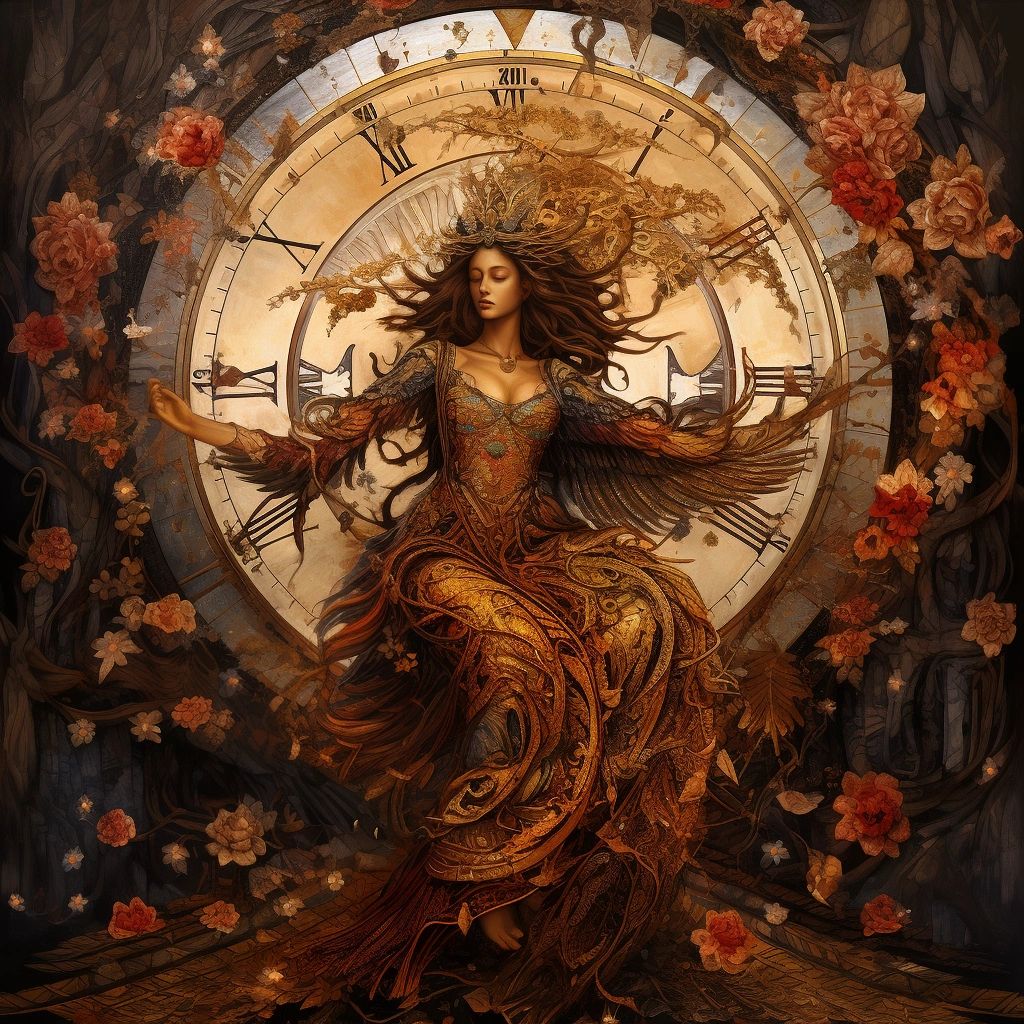
Two levels further down waits the figure readers of this site know best. Sophia is the youngest of the emanations, the Wisdom who fell and rose, and in her the feminine divine acquires a biography, error and grief and restoration included. The tradition trusted a feminine figure with its entire plot. The world exists because of her crisis, the spark in you is her light, and the story’s happy ending is her homecoming, which makes every human awakening a chapter in a mother’s return. No other ancient cosmology hands wisdom herself this much of the script, error included, and the inclusion of the error is the point, since a feminine divine permitted to fail and rise is a far larger figure than one kept safely perfect on a pedestal.
Thunder, the Voice
Then there is the poem, and nothing in ancient literature sounds like it. Thunder: Perfect Mind is a monologue in a feminine voice that introduces herself through sustained, deliberate contradiction:
I am the first and the last. I am the honored one and the scorned one. I am the whore and the holy one. I am the wife and the virgin.
The site’s post on Thunder explores her fully. What matters for this survey is the strategy. Every culture sorts the feminine into tidy opposed boxes, honored or scorned, wife or whore, and this divine voice claims every box at once, which detonates the sorting system itself. The feminine divine, in her own voice, refuses to be split, and the refusal is presented as a revelation of what divinity is actually like.
Mary, the Human Echo
The pattern reaches ground level in a person. Across the Gnostic gospels, Mary Magdalene appears as the most advanced disciple, the one who understands first, asks the questions the men cannot form, and receives the teachings they are not ready to hear, to the recorded irritation of Peter. The texts stage the argument openly, and side with her. A tradition whose heavens run from Silence through Mother-Thought to Wisdom was never going to be surprised that the star pupil was a woman.
Why It Was Buried
None of this is modern projection onto ancient texts. These documents are among the oldest Christian literature that survives, and the consolidating church knew exactly what was in them. As orthodoxy standardized its language toward Father and Son, the books that remembered the Mother, the Silence, and the undivided voice became liabilities, and the burial at Nag Hammadi preserved, among much else, precisely this half of the early Christian imagination. What came back out of the jar in 1945 included the feminine divine, intact, waiting.
Practicing the Levels
Each level offers something usable this week. Honor the Silence by beginning one prayer or sitting with a full minute of wordlessness, treating the quiet as the older partner rather than the empty part. Borrow Barbelo’s grammar once, addressing the divine as Mother-Father and watching what shifts when the address refuses to choose. And take Thunder’s audit, since her poem exposes the sorting every mind still runs. Somewhere you are splitting a woman, or the feminine in yourself, into honored and scorned boxes, and the voice from the jar is on record about what she thinks of the boxes.
The old map put Silence beside the Depth at the beginning of everything. The tradition that drew it was buried for fifteen centuries and has outlasted its buriers, and her half of the map is open again.
The Secret Book of John and Thunder: Perfect Mind are quoted from Marvin Meyer’s translations in The Nag Hammadi Scriptures (HarperOne, 2010). The Depth and Silence pairing follows Irenaeus’s account of the Valentinian system.