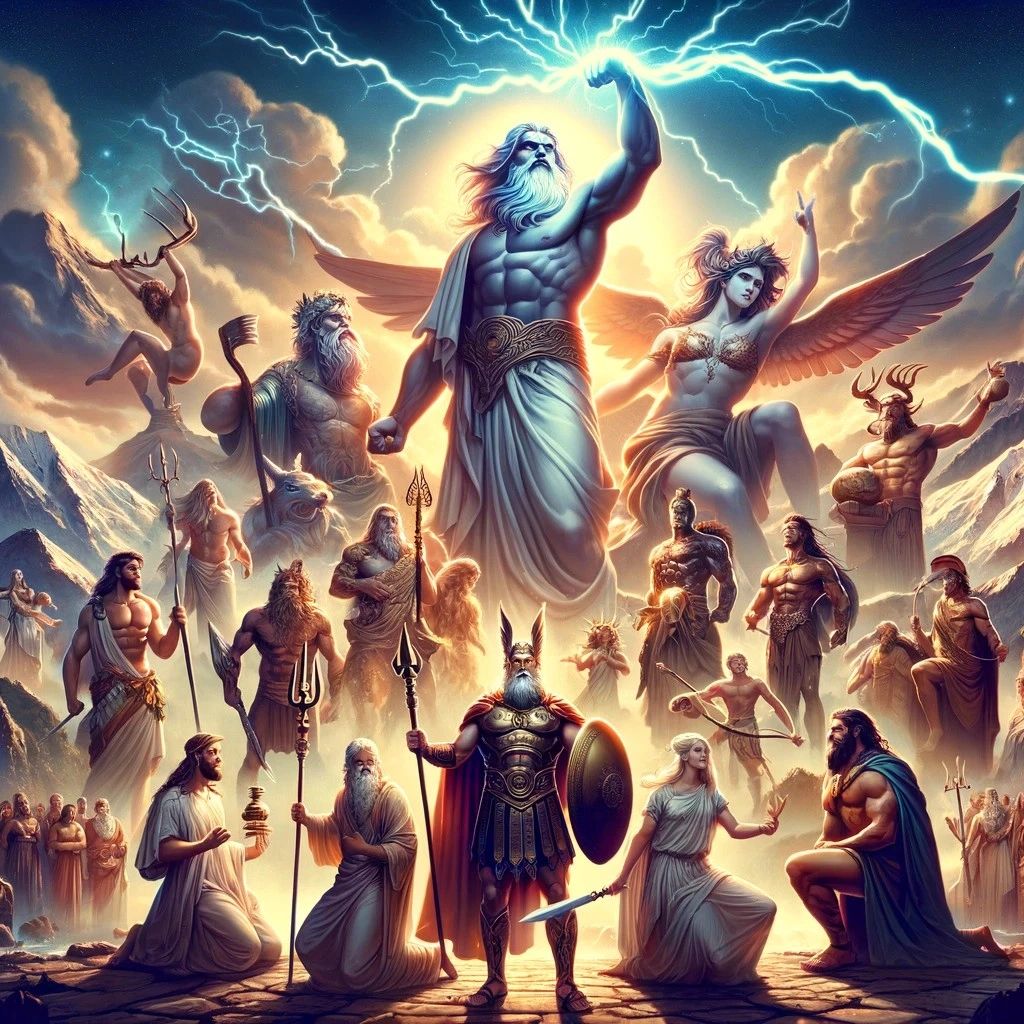
Greek Mythology

An Overview of Greek Mythology

Greek mythology represents a rich tapestry woven from the threads of human imagination and the quest for understanding the world’s mysteries. This ancient system encompasses gods, goddesses, heroes, and monsters embodying natural forces and human characteristics. The Major Pantheon The primary deities resided on Mount Olympus, each governing specific domains: Zeus: King of gods; rules sky and thunder Hera: Queen of gods; goddess of marriage and childbirth Poseidon: God of the sea, earthquakes, and horses Demeter: Goddess of agriculture, harvest, and fertility Athena: Goddess of wisdom, warfare, and crafts Apollo: God of sun, music, healing, and prophecy Artemis: Goddess of hunt, wilderness, and childbirth Ares: God of war’s brutal aspects Aphrodite: Goddess of love, beauty, and desire Hephaestus: God of fire and metalworking Hermes: Messenger god; guide to the Underworld Hestia: Goddess of hearth, home, and family History and Creation Myth The myths evolved over centuries, influenced by Minoan and Mycenaean civilizations. Homer’s Iliad and Odyssey, along with Hesiod’s Theogony (circa 8th century BCE), codified oral traditions into literary form. ...

February 8, 2024 · 2 min · The Satori Stream
The Mystery of Atlantis

Unraveling the Mystery of Atlantis: From Plato's Tales to Modern Theories

Plato’s Account of Atlantis The oldest mentions of Atlantis appear in Plato’s dialogues “Timaeus” and “Critias,” composed around 360 BCE. Plato depicted Atlantis as a powerful and advanced kingdom that existed about 9,000 years before his time, positioned beyond the “Pillars of Hercules.” He portrayed it as a sophisticated naval civilization that eventually sank into the ocean as divine punishment following its defeat by the Athenians. Scholars continue debating whether Plato intended this narrative as historical fact, philosophical metaphor, or mythological tale. ...

February 8, 2024 · 2 min · The Satori Stream
The Fall of Sophia

The Fall of Sophia

Introduction to Gnostic Cosmology Gnosticism emphasizes gnosis, or direct knowledge of the divine. The tradition features a dualistic worldview separating the spiritual realm (pleroma) from the material world, viewed as flawed creation. A supreme, unknowable God emanates a series of divine beings or aspects. The Role of Sophia in Gnostic Mythology Sophia, meaning “wisdom” in Greek, represents a significant aeon or divine emanation. She embodies a dual nature, both divine wisdom and personified folly. This duality proves essential to understanding her narrative and the material world’s origins. ...

February 7, 2024 · 2 min · The Satori Stream

Stay Connected

Subscribe for updates on spirituality, technology, and the journey within.