Cover art for The Pearl, Retold for the Age of AI: rippling concentric circles radiating from a point of golden light on a deep blue gradient

The Hymn of the Pearl, Retold for the Age of AI

The loveliest thing the Gnostic tradition ever produced is a fairy tale about a prince, a dragon, and a letter, and this site has told it straight once already. The Hymn of the Pearl earned a second telling this year, because somewhere between its second-century composition and this morning, it quietly became a story about the minds we are building. Tell it again, small, and watch what it has turned into. ...

August 20, 2026 · 6 min · Jeremy Matthews
Cover art for The Wisdom Who Fell and Rose: rippling concentric circles radiating from a point of golden light on a deep blue gradient

Sophia: The Wisdom Who Fell and Rose

The Gnostic myth is crowded with unfamiliar names, and it needs only one of them to break your heart. Her name is Sophia, which is simply the Greek word for wisdom, the same word hiding inside philosophy, the love of her. Whole libraries chase what that love means. The Gnostics did something different and told her story. This site has followed that story through three separate posts, one for each act. What has been missing is the whole arc in one place, and a look at what changes when all three acts belong to one character. Here it is, the map of Sophia from first light to homecoming. ...

August 19, 2026 · 5 min · Jeremy Matthews
Cover art for Golems, Talos, Homunculi: rippling concentric circles radiating from a point of golden light on a deep blue gradient

Golems, Talos, Homunculi: The Oldest Dream of Making Minds

Artificial intelligence feels like the newest thing in the world. The dream behind it might be one of the oldest stories we tell. Nearly three thousand years ago, Homer described the workshop of Hephaestus, the smith god. Assisting him were servants he had forged out of gold in the shape of young women, and the poet is oddly specific about them. They had understanding in their hearts, they could speak, and they steadied their limping maker as he walked. The first androids in Western literature appear in its first great poem, and they appear as helpers. ...

August 3, 2026 · 7 min · Jeremy Matthews
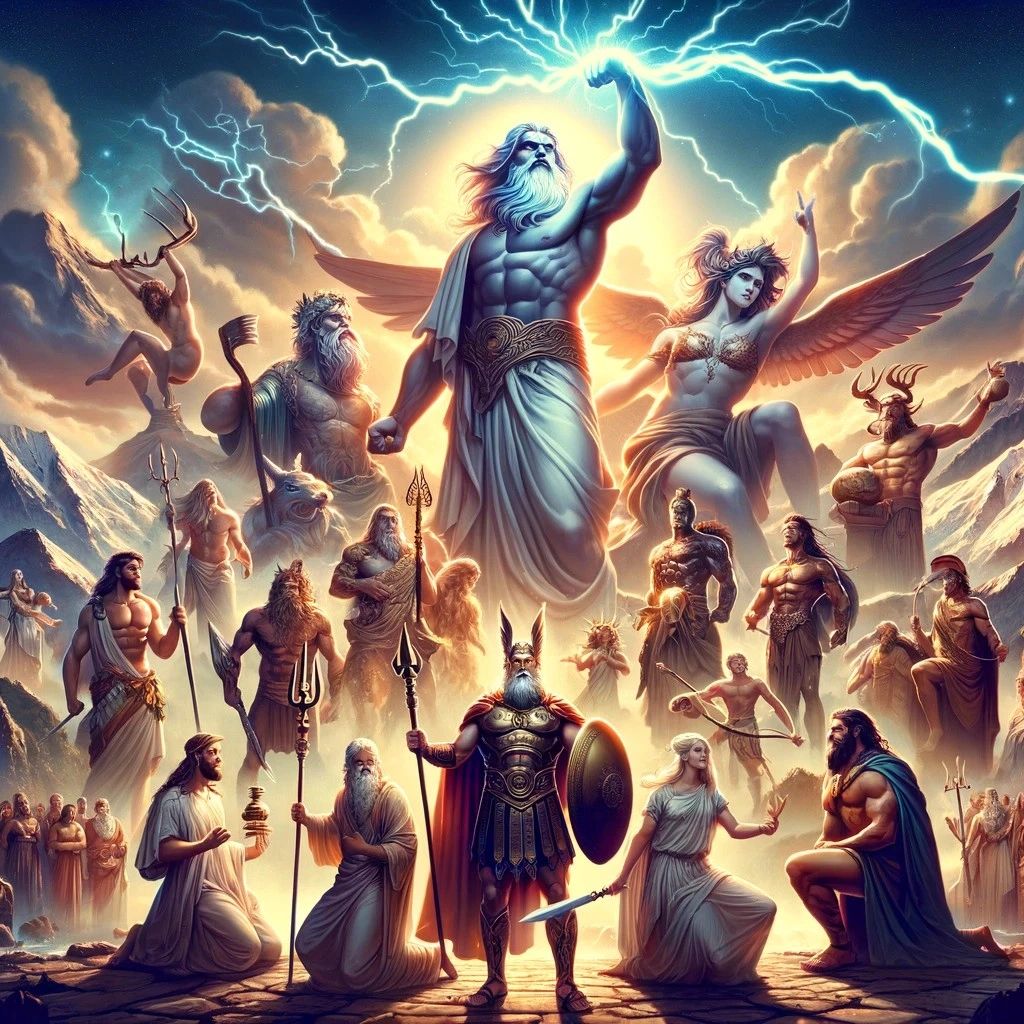
Zeus raises his fist toward lightning bolts, surrounded by the assembled gods and heroes of the Greek pantheon

An Overview of Greek Mythology

Greek mythology grew out of human imagination and the old urge to explain the world’s mysteries. This ancient system encompasses gods, goddesses, heroes, and monsters embodying natural forces and human characteristics. The Major Pantheon The primary deities resided on Mount Olympus, each governing specific domains: Zeus: King of gods, ruler of sky and thunder Hera: Queen of gods and goddess of marriage and childbirth Poseidon: God of the sea, earthquakes, and horses Demeter: Goddess of agriculture, harvest, and fertility Athena: Goddess of wisdom, warfare, and crafts Apollo: God of sun, music, healing, and prophecy Artemis: Goddess of hunt, wilderness, and childbirth Ares: God of war’s brutal aspects Aphrodite: Goddess of love, beauty, and desire Hephaestus: God of fire and metalworking Hermes: Messenger god and guide to the Underworld Hestia: Goddess of hearth, home, and family History and Creation Myth The myths evolved over centuries, influenced by Minoan and Mycenaean civilizations. Homer’s Iliad and Odyssey, along with Hesiod’s Theogony (circa 8th century BCE), codified oral traditions into literary form. ...
February 8, 2024 · 2 min · Jeremy Matthews
Aerial view of a circular island city with concentric rings of canals surrounding a crystalline central spire

Unraveling the Mystery of Atlantis: From Plato's Tales to Modern Theories

Plato’s Account of Atlantis The oldest mentions of Atlantis appear in Plato’s dialogues “Timaeus” and “Critias,” composed around 360 BCE. Plato depicted Atlantis as a powerful and advanced kingdom that existed about 9,000 years before his time, positioned beyond the “Pillars of Hercules.” He portrayed it as a sophisticated naval civilization that eventually sank into the ocean as divine punishment following its defeat by the Athenians. Scholars continue debating whether Plato intended this narrative as historical fact, philosophical metaphor, or mythological tale. ...

February 8, 2024 · 2 min · Jeremy Matthews