Cover art for The Science of Awe: rippling concentric circles radiating from a point of golden light on a deep blue gradient

The Science of Awe: What Researchers Are Learning About Self-Transcendence

For most of its history, scientific psychology kept a careful distance from wonder. Fear, anger, disgust, and sadness all got decades of attention, partly because they are easy to trigger in a lab. Awe had to wait until 2003, when Dacher Keltner and Jonathan Haidt published the paper that finally gave it a working definition. Two decades later, awe has become one of the busiest corners of emotion science. The findings would not startle anyone who has spent time with the mystics. What might startle you is how literal the confirmation has become, right down to measuring the size of the self in the pixels of a selfie. ...

August 6, 2026 · 6 min · Jeremy Matthews
Cover art for Jung's Seven Sermons to the Dead: rippling concentric circles radiating from a point of golden light on a deep blue gradient

Jung's Seven Sermons to the Dead

On a summer Sunday in 1916, the front doorbell of Carl Jung’s house on Lake Zurich began ringing frantically. The whole family heard it, and the maids in the kitchen could see the bell plate swinging. Nobody stood at the door. The days leading up to it had been strange in his telling. His children were having anxious dreams, the air of the house felt thick, and Jung described the place as feeling crammed full of presences. Out of that crowded atmosphere came, as he experienced it, a question from the dead, and over three evenings he wrote them an answer. The haunting, he reported, ended the moment his pen touched paper. ...

August 4, 2026 · 6 min · Jeremy Matthews
Cover art for The Battle Within: rippling concentric circles radiating from a point of golden light on a deep blue gradient

The Battle Within: Understanding the Counterfeit Spirit

You know the feeling. You’ve decided to meditate, to read something meaningful, to finally start that practice you’ve been putting off. And then something else happens. You reach for your phone. You scroll. You tell yourself you’ll start tomorrow. One part of you wants to grow. Another part wants to stay comfortable. One voice calls you toward the light. Another whispers that the light can wait. The ancient Gnostic teachers had a name for this experience. They called it the war between the light-power and the counterfeit spirit. ...

January 31, 2026 · 9 min · Jeremy Matthews
Dark fantasy painting of a lion-headed archon with a muscular human body, evoking the Gnostic ruler Yaldabaoth

What Are the Archons and Why Should You Care?

The Gnostic texts describe a class of beings called archons. The word comes from Greek, meaning “rulers” or “authorities.” They’re the powers that govern the material world under the direction of the Demiurge. This might sound like ancient mythology irrelevant to modern life. But the archons describe something you experience every day. Who Are the Archons? According to texts like the Apocryphon of John and the Hypostasis of the Archons, the archons were created by the Demiurge to help administer the material cosmos. They’re associated with the seven classical planets, each governing a sphere through which the soul descends at birth and must ascend at death. ...

January 31, 2026 · 7 min · Jeremy Matthews
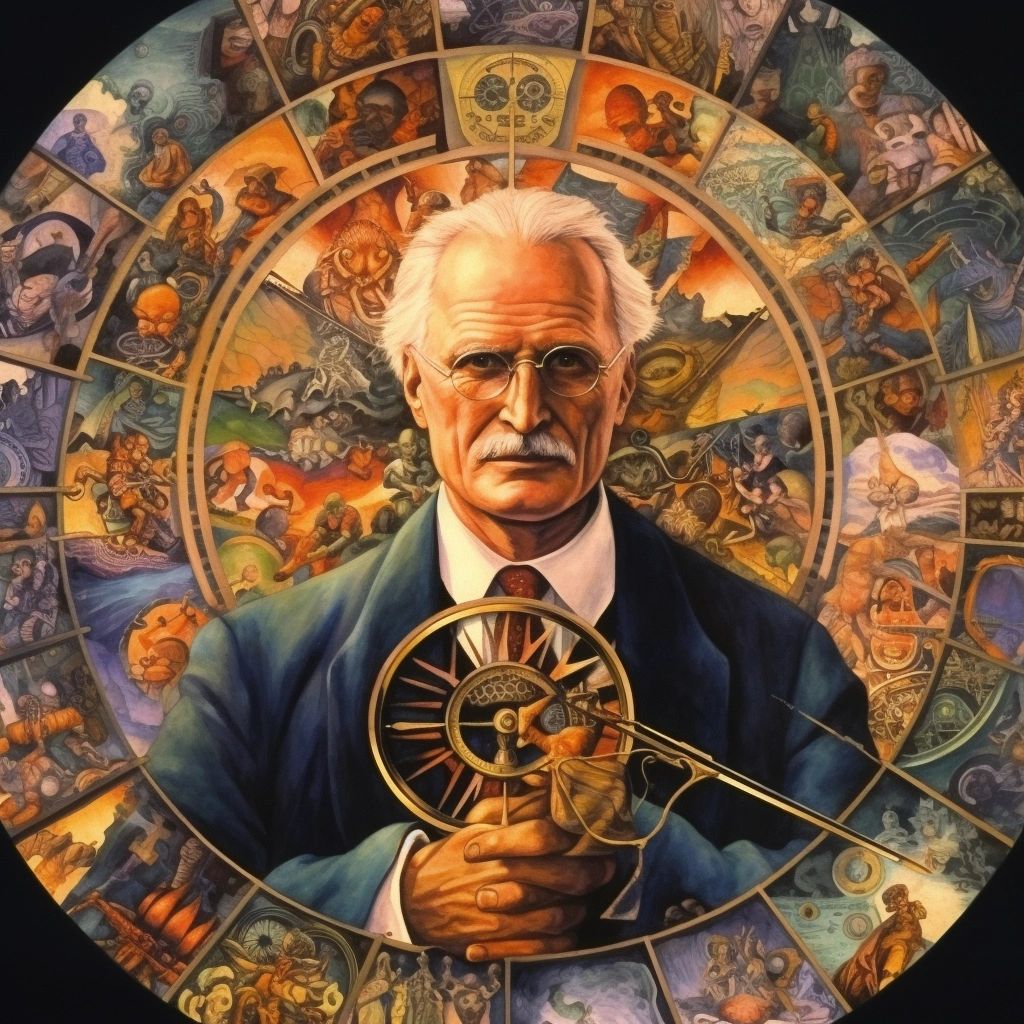
Illustrated portrait of Carl Jung holding an astrolabe at the center of a mandala of archetypal scenes

Carl Jung: His Life and Contributions to Psychology

Carl Gustav Jung was born on July 26, 1875, in Switzerland and became a pioneering psychiatrist and psychoanalyst who established analytical psychology as a distinct field. His influential work extended across psychiatry, anthropology, archaeology, literature, philosophy, and religious studies. Early Collaboration and Divergence Jung initially collaborated closely with Sigmund Freud, contributing significantly to psychoanalytic theory development. However, theoretical disagreements led him to forge his own path and develop independent psychological frameworks. ...

February 7, 2024 · 2 min · Jeremy Matthews
A glowing figure descends through parted clouds in a column of radiant light toward a person standing in still water

How to Apply Gnosis to Attain Inner Harmony

Introduction The Gnostic myth, particularly the narrative of the Fall of Sophia, offers psychological and spiritual insights that can be applied to our personal lives and inner development. This ancient framework provides a metaphorical lens for understanding the human psyche, self-awareness, and the pursuit of meaning. The Inner Sophia: Wisdom and Folly Within Sophia represents the dual aspects of human consciousness, both wisdom and folly. Just as Sophia’s desires lead to an unintended fall, individuals encounter their own challenges through unconscious drives, ignorance, or misplaced understanding. This fall represents an invitation to explore one’s inner depths, confronting shadows, fears, and avoided aspects of self. From there the movement runs from unconsciousness toward greater self-awareness. ...

February 7, 2024 · 2 min · Jeremy Matthews